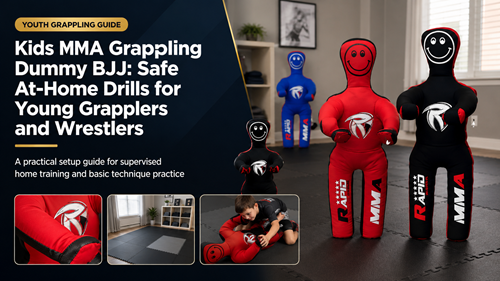
The Kids MMA Grappling Dummy BJJ is an unfilled youth training dummy intended for wrestling, Brazilian Jiu-Jitsu, MMA, judo, and other grappling practice. Similar MatArts listings describe 40-inch and 47-inch youth versions, a canvas-style body, moveable limbs, and filling with soft textile materials such as old clothing, towels, blankets, polyfill, or fabric. Parents should avoid sand, sharp items, or any filling that creates hard impact points.
A dummy can provide extra repetitions at home, but it is not a substitute for a coach, live partner, safe mat space, or age-appropriate instruction. The best home drills are controlled positional movements that the child already understands. The Kids MMA Grappling Dummy BJJ should be used on a clear padded surface with adult supervision and without high-amplitude throws, dangerous joint locks, or unsupervised rough play.
Set Up the Kids MMA Grappling Dummy BJJ for Home Practice
Because the dummy is unfilled, the final firmness and weight depend on what goes inside. Soft shredded clothing, towels, blankets, or polyfill can create a more forgiving training surface. Fill evenly so the torso and limbs bend without hard lumps. Do not use sand, metal, wood, rocks, or sharp material.
The training area should be free of furniture edges, walls, glass, pets, siblings, and loose equipment. A proper wrestling or grappling mat is preferable to carpet over a hard floor. The child should have enough space to move around the dummy without striking nearby objects.
Parents should decide the drill before practice starts. A short set of known positions is safer and more productive than letting a child invent throws or submission attempts. The dummy cannot give feedback, resist realistically, or signal pain, so technique quality still depends on coaching.
Safe At-Home Drill Progression for Young Grapplers
Use low-impact drills that reinforce movement patterns rather than encouraging children to throw the dummy as hard as possible.
- Check that the room and mat area are clear
- Inspect seams and zipper before each session
- Confirm filling is soft and evenly distributed
- Start with stance and level changes beside the dummy
- Practice controlled penetration-step entries
- Use simple top-position transitions already taught by a coach
- Practice breakdown positioning without dangerous torque
- Stop if the child loses control of the dummy
- Keep sessions short and supervised
A training dummy should increase repetition quality, not encourage unsupervised techniques. If the child has not learned the movement from a qualified coach, home practice should wait.
What a Youth Grappling Dummy Can and Cannot Teach
A dummy is useful for repetition but cannot reproduce a live opponent’s balance, reaction, pressure, or safety feedback.
| Training Goal | Useful with Dummy? | Important Limit |
|---|---|---|
| Stance and level changes | Yes | Dummy is mostly a visual target |
| Penetration-step positioning | Yes | No realistic opponent reaction |
| Top-position movement | Yes | Requires prior coaching |
| Live takedown timing | Limited | No active resistance or balance |
| Submissions | Not for unsupervised youth use | Dummy cannot signal pain |
| Conditioning circuits | Possible | Adult must control intensity and space |
Home Drill and Youth Training References
The supportive keywords are separated into individual paragraphs so parents can follow the reference that matches the drill they are planning.
For kids grappling dummy drills review the site product listing and confirm current size, package contents, and filling instructions.
For a youth wrestling practice dummy compare other dummy sizes and styles before choosing by appearance alone.
For a home takedown training aid make sure the training surface is appropriate before adding repeated entries or controlled takedown movement.
For beginner BJJ dummy exercises compare body shape and filling requirements with the exact positions the child is learning.
For child-friendly grappling practice use the NFHS coaching resource as a reference for risk management, basic skills, and practice preparation.
For solo youth wrestling drills keep the home routine connected to appropriate wrestling equipment rather than unsafe improvised objects.
Parents should treat the dummy as a practice tool, not a coach. Technique, intensity, and progression should still come from qualified instruction.
Supervision, Filling, and Equipment Checks
Inspect the dummy before every session for open seams, zipper damage, exposed filling, hard lumps, or anything that could scratch the child. Redistribute soft filling if the torso or limbs become uneven.
Keep the mat area clean and dry, and store the dummy where younger children cannot climb on it unsupervised. If the product cover can be cleaned, follow the current manufacturer directions rather than soaking or machine washing a material that is not designed for it.
Avoid high-amplitude throws, neck cranks, uncontrolled joint locks, striking drills, or any activity that could send the child into a wall or hard floor. Stop training when fatigue causes sloppy movement.
For youth wrestling safety and practice planning, review the NFHS Coaching Wrestling resource covering risk management, basic skills, warm-up, and practice preparation.
Frequently Asked Questions
Does the Kids MMA Grappling Dummy BJJ come filled?
The referenced youth MatArts-style listings are unfilled. Verify the exact site product description before ordering.
What should parents use to fill a youth grappling dummy?
Use soft textile materials such as shredded clothing, towels, blankets, or polyfill when the product instructions allow them. Avoid sand and sharp objects.
Can a child practice takedowns on a dummy at home?
Only controlled movements already taught by a coach, on an appropriate padded surface, with adult supervision and enough clear space.
Can a dummy replace live wrestling practice?
No. It cannot reproduce balance, reaction, pressure, timing, or safety feedback from a trained partner and coach.
How long should youth home sessions last?
Keep sessions short enough that technique stays controlled. Stop when fatigue, frustration, or loss of focus reduces safe movement.
Use the Kids MMA Grappling Dummy BJJ as a Repetition Tool, Not a Substitute for Coaching
The Kids MMA Grappling Dummy BJJ can give young wrestlers and grapplers a convenient target for controlled positions, entries, and movement patterns at home. Its usefulness depends on soft even filling, a safe padded area, adult supervision, and drills the child already understands.
Keep intensity low, avoid dangerous submissions and throws, and connect home repetitions to the athlete’s real coaching plan. A dummy is most valuable when it reinforces good technique rather than encouraging unsupervised experimentation.
