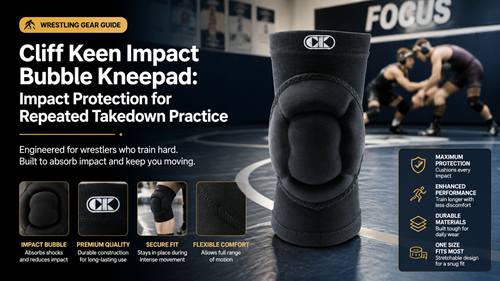
The Cliff Keen Impact Bubble Kneepad is designed around a compression-molded bubble that sits over the knee and an ergonomic shape intended to move with a wrestler. Cliff Keen lists the current Impact with a soft rib-knit polyester body, composite foam pad, compression-molded bubble, and a machine-wash-cold, air-dry care routine. For wrestlers doing high-volume takedown repetitions, those details matter because the same knee may contact the mat dozens of times in one drilling block.
Repeated shots create a different demand from occasional kneeling. The Cliff Keen Impact Bubble Kneepad needs to stay centered through penetration steps, re-attacks, mat returns, sprawls, and scramble recovery without becoming unstable as the athlete sweats. The protective bubble is only useful when its position, fit, and foam recovery remain consistent across the full practice.
How the Cliff Keen Impact Bubble Kneepad Handles Repeated Contact
Cliff Keen describes The Impact with patented ergonomic construction and an anatomically compression-molded bubble. That shape is intended to conform around the knee and distribute high-impact contact while allowing normal wrestling movement. The current manufacturer page lists soft rib-knit polyester and a composite foam pad.
For takedown practice, the important detail is not just initial softness. Foam must return toward its original shape between repetitions, while the surrounding fabric has to keep the protective area over the patella. A bubble that rotates to the side during re-shots no longer protects the contact point it was purchased for.
Durability should also be evaluated after washing. Cliff Keen currently directs machine washing cold in a laundry bag with like items, followed by air drying and a synthetic-fiber-safe detergent. Following those directions helps preserve the materials and makes practice hygiene easier to manage.
Takedown Drill Test for Bubble Padding
Use a staged drill test so impact volume increases only after the pad proves stable at lower intensity.
- Confirm the current Cliff Keen size chart
- Center the bubble directly over the kneecap
- Perform slow penetration steps on both sides
- Add ten controlled takedown entries
- Run re-shot sequences after a sprawl
- Check bubble position every few repetitions
- Increase pace only if the pad stays centered
- Inspect foam recovery after the drill block
- Repeat the check after the first wash
If the bubble shifts, folds, or feels permanently compressed after normal use, stop judging it by brand reputation and reassess fit or replacement timing.
Impact Cushioning Versus Mobility
The bubble design should add protection without making the wrestler change normal technique.
| Training Demand | What the Bubble Should Do | Warning Sign |
|---|---|---|
| Penetration step | Cover the primary contact area | Pad rotates on landing |
| Re-shots | Recover between contacts | Foam stays flattened |
| Sprawls | Allow deep knee flexion | Back area bunches |
| Scrambles | Stay centered during rotation | Sleeve twists sideways |
| Long practice | Remain comfortable when warm | Heat or pressure becomes distracting |
| Washing | Maintain shape and seams | Padding separates or fabric stretches |
Impact, Takedown, and Durability References
These supportive keywords are distributed across separate paragraphs so each link has a clear purpose.
For bubble pad shock absorption review Cliff Keen’s current description of the compression-molded bubble and ergonomic construction.
For a takedown drill knee guard compare the pad with the demands of repeated practice entries and mat contact.
For the Cliff Keen impact cushion review the site product record before ordering a specific variation.
For repeated shot knee protection compare thick and thin cushioning strategies instead of choosing only by visual pad size.
For wrestling landing support consider coverage, pad position, and sensitive-knee comfort during landing and recovery.
For practice kneepad durability compare this takedown-focused article with the August review centered on repeated mat contact and long-term use.
A high-volume takedown pad should protect the same location on repetition fifty that it covered on repetition one.
Care the Bubble So the Pad Keeps Its Shape
Follow Cliff Keen’s current cold-machine-wash guidance, use a laundry bag with like items, and air dry. Avoid high heat because foam, elastic, and fabric can change shape when exposed to aggressive drying.
After each practice, let the kneepad dry before closing it inside a gear bag. Inspect the bubble for permanent compression, cracking, separation, or movement inside the fabric shell.
Protective padding can reduce direct mat contact, but it cannot make an unsafe technique or injured knee safe. Stop training and seek appropriate assessment for persistent pain, swelling, instability, or numbness.
For current manufacturer details, review Cliff Keen The Impact for materials, features, colors, sizing, and care.
Frequently Asked Questions
What is the bubble in the Cliff Keen Impact Kneepad?
Cliff Keen describes an anatomically compression-molded bubble designed to provide focused high-impact protection over the knee.
Is the Impact Bubble good for repeated takedown drilling?
It can be when the pad stays centered, the foam recovers between contacts, and the fit remains comfortable through the full session.
How should the Cliff Keen Impact be washed?
The current manufacturer page says machine wash cold in a laundry bag with like items and air dry with a synthetic-fiber-safe detergent.
Does thicker padding automatically mean better protection?
No. Coverage, fit stability, movement, and the location of the padding matter as much as thickness.
When should an Impact Bubble kneepad be replaced?
Replace it when the foam remains flattened, seams fail, fabric stretches out, or the bubble can no longer stay positioned over the knee.
Is the Cliff Keen Impact Bubble Kneepad a Good Takedown-Practice Choice?
The Cliff Keen Impact Bubble Kneepad is built around a focused cushioning concept that suits wrestlers who repeatedly contact the mat during shot practice. Its value is strongest when the bubble stays centered, the fabric moves naturally, and the foam recovers across a high-volume session.
Use the current size chart, test the pad progressively, follow Cliff Keen care instructions, and replace it when fit or foam performance changes. That approach makes the product decision about repeatable practice performance rather than appearance alone.
