

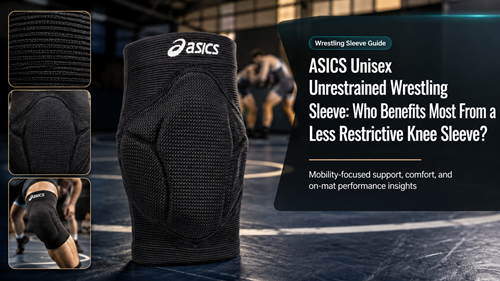
The ASICS Unisex Unrestrained Wrestling Sleeve is a product-specific option for men and women seeking lightweight, less restrictive wrestling support. The useful question is not whether one knee pad is universally “better,” but whether its padding shape, sleeve construction, coverage, ventilation, and fit match the way an athlete actually trains. Its product record emphasizes dual-density KinetoFoam, a nine-inch sleeve, a terry-loop interior, and a mesh back, which points toward a movement-first design rather than the thickest possible pad.
The supplied product record describes dual-density KinetoFoam padding, a nine-inch sleeve length, and a terry-loop inner fabric and mesh back panel. Those details give us a practical basis for evaluating the pad without inventing claims that are not present in the product information. Fit and comfort still vary by wrestler, so the safest buying approach is to compare the listed construction with real practice demands.
How the ASICS Unisex Unrestrained Wrestling Sleeve Is Built
The strongest part of this evaluation is the construction information already attached to the product. The record identifies dual-density KinetoFoam padding. It also notes a nine-inch sleeve length. Together, those details help explain what the pad is trying to balance: protection around the kneecap, freedom to bend the leg, and enough sleeve control to keep the protective area where it belongs during motion.
A third useful point is a terry-loop inner fabric and mesh back panel. The mesh back and longer sleeve can help distribute fit across more of the leg while still leaving the joint free to flex. That does not guarantee the same experience for every wrestler, because leg shape, sweat level, stance, mat texture, and training duration all change how a sleeve feels.
The remaining product detail—a latex-free imported construction sold as a single sleeve—is especially relevant to men and women seeking lightweight, less restrictive wrestling support. It should be treated as a design characteristic to test rather than a promise of injury prevention. Protective equipment can reduce direct contact and improve comfort, but it cannot eliminate the possibility of pain or injury during wrestling.
Mobility Test for a Less Restrictive Sleeve
A movement-first sleeve should be tested through range of motion and quick transitions. Look for stable coverage without resistance at the back of the knee.
- Perform deep stance holds
- Cycle through level changes
- Drill low singles and doubles
- Add sprawls and hip switches
- Check sleeve length on full extension
- Inspect mesh-back comfort after sweating
- Test movement on both offensive and defensive sequences
- Confirm no edge rolling after live work
Less restrictive should not mean loose. If the sleeve rotates freely around the leg, protection will not stay where the knee meets the mat.
Freedom of Movement Versus Pad Structure
A lighter-feeling sleeve can improve mobility, but wrestlers who take heavy direct knee contact may still prefer thicker front padding.
| Evaluation Point | What to Look For | Possible Trade-Off |
|---|---|---|
| KinetoFoam | Dual-density cushioning concept | May feel different from gel or EVA |
| 9-inch sleeve | More leg contact for stability | More fabric on the leg |
| Mesh back | Ventilation and flex | Can snag if damaged |
| Terry lining | Softer interior feel | Needs complete drying |
| Single sleeve | Buy only what is needed | Two knees require two units |
Who Benefits Most From the Unrestrained Design
The following six comparisons separate mobility, fit, and coverage questions into individual paragraphs.
For unrestricted wrestling knee sleeve, review the original listing’s KinetoFoam, mesh-back, and nine-inch details before comparing alternatives.
For flexible wrestler support, compare lightweight designs when free knee flexion is more important than maximum pad thickness.
For lightweight knee coverage, look at sleeve-style options if you want coverage that follows the leg rather than a pronounced front cap.
For free movement wrestling gear, keep the knee sleeve in context with the rest of the athlete’s practice equipment and mobility needs.
For neutral fit wrestling sleeve, use actual leg measurement instead of assuming that a unisex label means one fit works for every body shape.
For mobility knee protection, compare the older Unrestrained design with ASICS’s current sleeve range for modern fit and cushioning context.
This type of sleeve is especially attractive to speed-focused wrestlers who notice bulky pads during re-attacks, stand-ups, and extended scrambles.
Care and Practice Use
Before the first hard session, wear the ASICS Unisex Unrestrained Wrestling Sleeve during stance work, level changes, light shots, sprawls, and short live exchanges. A pad that feels fine while standing can shift when the knee is repeatedly flexed or dragged across the mat. Check the front alignment after each drill rather than waiting until the end of practice.
Mesh and terry-style interior fabrics need regular cleaning and full drying. Inspect the mesh for stretching or tears because a damaged back panel can change how the front pad tracks the knee.
If the sleeve rolls, pinches behind the knee, goes numb, causes persistent skin irritation, or repeatedly exposes the kneecap during normal movement, the fit or model is not working well for that athlete. Do not compensate by over-tightening or adding improvised straps that change circulation or movement.
Frequently Asked Questions
Is the ASICS Unisex Unrestrained Wrestling Sleeve a good choice for daily practice?
It can be a practical option when its fit, padding, and coverage stay comfortable through the drills you repeat most. Test it in progressive practice blocks instead of judging from a short try-on.
How tight should the ASICS Unisex Unrestrained Wrestling Sleeve feel?
It should feel secure enough to keep the protective area aligned without numbness, tingling, sharp pressure, or deep marks. Follow the listed size guidance and reassess after the sleeve becomes damp.
Should a wrestler wear one knee pad or two?
That depends on training habits, coach preference, mat contact, and whether one or both knees take repeated impact. The product listing should also confirm whether the package contains one pad or a pair.
How should a wrestling knee pad be tested before competition?
Use it first during drilling and controlled live work. Check movement, slipping, heat, seam irritation, and whether the pad remains centered after shots, sprawls, and scrambles.
Does more padding always mean better protection?
No. More padding can increase cushioning but may also add bulk, heat, or movement restriction. The better choice is the amount and shape of padding that stays positioned during the athlete’s real wrestling movement.
Who Should Consider the ASICS Unisex Unrestrained Wrestling Sleeve?
The Unrestrained sleeve is worth considering for wrestlers who prioritize mobility, a longer sleeve, and moderate padding. It is a poor choice if the fit rotates or if the athlete needs the dense front protection of a thicker dedicated knee pad.
