

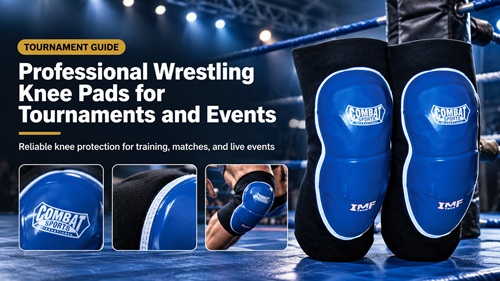

Professional wrestling knee pads for tournaments and events should feel secure, predictable, and easy to forget once the whistle starts. Competition is not the time to discover that a sleeve slides after warm-up, a seam rubs behind the knee, or a bulky pad changes stance depth.
Tournament-ready wrestling equipment should be tested in advance during normal drilling and live work. Athletes, coaches, and parents should also confirm event rules, team color expectations, product condition, and whether the gear is sold as one pad or a pair.
What Professional Wrestling Knee Pads Need
Professional wrestling knee pads need reliable placement first. A protective panel that rotates off the kneecap can lose value quickly during a scramble. The sleeve should keep the pad aligned through stance work, shots, sprawls, stand-ups, and short explosive exchanges.
Competition gear should also be consistent across repeated matches. A tournament can involve multiple warm-ups and bouts, so heat, moisture, compression, and pad recovery matter even when each match is short.
The site’s competition-grade knee pad guide gives another comparison point for athletes who want match-focused protective gear.
Rules, Fit, and Match-Day Checks
Check the current rules for the school, league, sanctioning body, or tournament before competition. Color, logos, hard components, exposed fasteners, and equipment condition can all matter depending on the event.
Fit should be verified using the manufacturer’s measurement method instead of a general clothing size. If the athlete is between sizes, test both when possible because different sleeve shapes can feel very different even at the same listed circumference.
Review the site’s wrestling knee pads for competition guide before finalizing tournament equipment.
Avoid Last-Minute Gear Changes
Use the same knee pad in at least one full practice before competition. New gear can feel different after sweat, repeated flexion, and mat contact, so a short dry try-on is not enough.
Protection Without Losing Mobility
Professional wrestling knee pads should protect without forcing the athlete into a different movement pattern. Deep knee flexion, quick penetration steps, hip movement, and stand-ups should still feel natural.
Low-profile designs can reduce bulk, while thicker pads can add more cushioning. The better choice depends on where and how often the wrestler contacts the mat. A tournament athlete who rarely drops directly onto the kneecap may prioritize mobility more than a wrestler who repeatedly lands hard during shots.
Use the padded wrestling knee sleeve guide when comparing extended compression coverage with a traditional shorter pad.
| Tournament Check | Why It Matters | Pass Condition |
|---|---|---|
| Rule compliance | Avoid equipment problems at check-in | Pad meets current event requirements |
| Size and position | Keeps protection over the kneecap | No sliding or rotation during live movement |
| Warm-up comfort | Shows how the sleeve behaves with heat | No pinching, numbness, or constant adjustment |
| Match mobility | Protects without slowing technique | Normal stance, shots, sprawls, and recoveries |
| Condition | Reduces equipment failure risk | No torn seams, exposed padding, or weakened elastic |
Tournament and Event Preparation
Pack competition knee pads clean and fully dry. Damp gear can feel different, smell stronger, and become uncomfortable during a long event day. If the athlete uses different practice and competition pads, both should be familiar before travel.
Bring a backup when possible. A torn seam, lost pad, or unexpected fit problem is easier to handle when an already-tested alternative is available.
For athletes who also train heavily between events, the practice durability guide helps separate daily-use priorities from match-day priorities.
A Match-Readiness Test for Professional Wrestling Knee Pads
Run this test several days before the event so there is time to change equipment if the pad fails. Use the normal competition clothing and a realistic warm-up.
If the athlete has sensitive knees or pressure concerns, compare the result with the sensitive-knee protection guide before increasing compression.
- Confirm event rules and team requirements
- Measure the leg using the current size chart
- Wear the pad through the full warm-up
- Perform repeated stance and shot sequences
- Complete short live scrambles
- Check pad position after sweat builds
- Inspect seams and the rear-knee area
- Pack a tested backup if available
Frequently Asked Questions
What makes a knee pad tournament-ready?
Stable fit, legal construction, enough impact protection, good mobility, and proven comfort during realistic practice.
Should competition knee pads be tighter than practice pads?
Not automatically. They should be secure without excessive compression, numbness, or restricted movement.
Can brand-new knee pads be worn for the first time at an event?
It is better to test them in practice first so slipping, heat, and seam pressure are known before competition.
Do tournament rules require a certain color?
Requirements vary by organization and event, so athletes should confirm the current rules before match day.
Should a wrestler pack a backup knee pad?
A tested backup is useful when travel, multiple matches, or equipment wear creates a risk of failure.
Professional Tournament Gear Should Feel Predictable
Professional wrestling knee pads are valuable when they protect the knee without changing the athlete’s movement or demanding constant adjustment. Competition confidence comes from gear that has already been tested under pressure.
Confirm the rules, use the current sizing method, practice in the pad before the event, and inspect it again on match day. Reliable tournament protection should feel familiar from warm-up through the final whistle.
